
In complex industrial systems, performing maintenance or repairs on a pipeline often presents a significant challenge: how do you isolate a section of the pipe without shutting down the entire system? A complete shutdown can lead to costly downtime, production losses, and logistical nightmares. Fortunately, pipe freezing offers an ingenious and efficient solution. This technique allows for safe and effective isolation without interrupting the overall flow of operations.
This guide will explain what pipe freezing is, how it works, and its various applications across different industries. Understanding this method is crucial for maintenance managers, engineers, and facility operators looking to optimize their repair processes and minimize operational disruptions. By leveraging this technique, you can perform necessary work with precision and confidence, ensuring your systems remain robust and reliable.
Key Takeaways
- Efficient Isolation: Pipe freezing creates a solid ice plug within a pipe, effectively isolating a specific section for maintenance or repair without needing to drain the entire system.
- Minimal Disruption: This technique is ideal for critical systems where shutdowns are impractical or costly, such as in hospitals, data centers, and manufacturing plants.
- Versatile Application: Pipe freezing can be used on various pipe materials and sizes, handling a wide range of liquids from water to oils and chemicals, making it a flexible solution for many industries.
What Is Pipe Freezing?
Pipe freezing is a non-intrusive method used to isolate a specific section of a pipeline. It involves applying a cryogen—typically liquid nitrogen—to the external surface of the pipe. The intense cold rapidly freezes the liquid inside, forming a solid, high-pressure ice plug. This plug acts as a temporary valve, stopping the flow and allowing for safe maintenance, repairs, or modifications downstream.
Once the work is complete, the freezing agent is removed, and the ice plug is allowed to thaw naturally. The liquid returns to its normal state, and the system is back online with minimal interruption. The process is controlled and monitored by specialized technicians to ensure the integrity of the pipe and the safety of the operation.
The Pipe Freezing Process: A Step-by-Step Look
While it sounds straightforward, successful pipe freezing requires precision, expertise, and specialized equipment. Here’s how the professionals at SEALTEC approach the process:
- Initial Assessment and Planning: The first step is a thorough evaluation of the site. Our technicians assess the pipe’s material, diameter, wall thickness, and the type of liquid it contains. We also analyze the system’s operating pressure and temperature to ensure freezing is a viable and safe option. Flow conditions are critical; the liquid must be static for an effective ice plug to form.
- Site Preparation: The area around the pipe is cleared to ensure safe access and proper ventilation, which is crucial when working with liquid nitrogen. The section of the pipe to be frozen is cleaned of any insulation, paint, or rust to guarantee direct contact and efficient heat transfer.
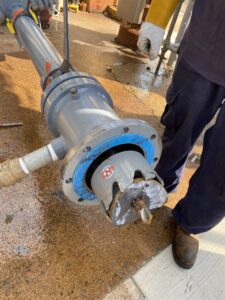
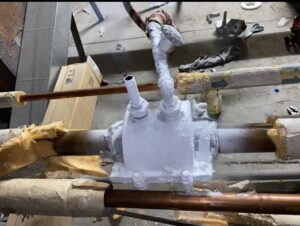
- Jacket Installation: A specially designed freezing jacket or coil is securely fitted around the pipe at the desired isolation point. This jacket is engineered to contain the liquid nitrogen and focus the cooling effect on a specific area, allowing for controlled and rapid plug formation.
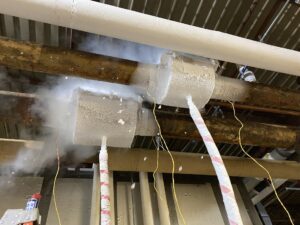
- Injecting the Cryogen: Liquid nitrogen, which has a boiling point of -196°C (-321°F), is slowly and carefully introduced into the jacket. Technicians meticulously monitor the pipe’s temperature using advanced thermal imaging and sensors to control the rate of freezing. This prevents thermal shock, which could damage the pipe.
- Formation of the Ice Plug: As the pipe’s temperature drops, the liquid inside begins to freeze from the outer wall inward, eventually forming a solid plug that spans the entire diameter of the pipe. The time required for this depends on the pipe size and the liquid inside. Our experts can verify the integrity of the plug, confirming it can withstand the system’s pressure.
- Performing the Maintenance Work: With the section securely isolated by one or two ice plugs, maintenance or repair work—such as valve replacement, pipe rerouting, or industrial leak sealing—can begin.
- Controlled Thawing: After the work is finished, the liquid nitrogen supply is stopped, and the jacket is removed. The ice plug is then allowed to thaw at a controlled rate. The system flow is gradually restored as the plug melts, and the pipeline returns to full operation.
When Is Pipe Freezing the Right Choice?
Pipe freezing is an invaluable technique in many scenarios, particularly when traditional methods are not feasible. Here are some common applications:
- Valve Replacement and Repair: When a valve fails and needs to be replaced, freezing the pipe on either side provides the necessary isolation without draining a large system.
- Emergency Repairs: For unexpected leaks or damage, pipe freezing offers a quick response to isolate the problem area, preventing extensive water damage or product loss.
- System Modifications: Adding new branches, tie-ins, or equipment to an existing pipeline can be done efficiently without a full system shutdown.
- Critical Facilities: In buildings like hospitals, data centers, and hotels, shutting down water or HVAC systems is not an option. Pipe freezing allows for essential maintenance without disrupting critical services.
- Industrial Plants: In manufacturing and processing plants, continuous operation is key to productivity. Pipe freezing allows for repairs without halting production lines.
This method is compatible with a wide array of pipe materials, including carbon steel, stainless steel, copper, and various plastics. It works on liquids such as water, oils, glycols, and many chemical solutions.
The SEALTEC Advantage: Partnering with Pipe Freezing Companies
While the concept of pipe freezing is simple, its execution is a science. Partnering with experienced pipe freezing companies like SEALTEC is essential for a successful and safe outcome. An inexperienced team can cause significant damage, leading to costly repairs and extended downtime.
At SEALTEC, our technicians are highly trained and equipped with the latest technology to handle any pipe freezing challenge. We bring decades of experience in specialized industrial services, including industrial leak sealing, ensuring that every job is performed to the highest standards of safety and quality. Our commitment is to provide solutions that not only solve the immediate problem but also enhance the long-term reliability of your systems.
Secure Your Systems with Expert Pipe Freezing
Pipe freezing is more than just a convenient repair method; it is a strategic tool for modern asset management. By enabling targeted maintenance without widespread system shutdowns, it helps organizations save time, reduce costs, and maintain operational continuity. Whether you’re facing an emergency repair or planning a system modification, this technique offers a reliable and efficient path forward.
If you are looking for a trusted partner to handle your pipeline isolation needs, look no further than SEALTEC. Our team is ready to provide the expert service you require to keep your operations running smoothly. Contact us today to learn more about our pipe freezing services and how we can support your maintenance goals.